
A House Built on Sand – The Junta's Election Plan
Introduction
The junta, which seized power on February 1, 2021, dissolved its administrative body, the "State Administration Council", on July 31, 2025, the 1,641st day since the coup, and announced plans to hold an election. Junta leader Min Aung Hlaing remains acting president, and has formed the "National Security and Peace Commission" and taken its chair.
The nationwide state of emergency was lifted, while 63 townships remain under a state of emergency.
At the July 31 National Defence and Security Council meeting, the junta leader said the election will use a "Mixed Member Proportional" system.
In preparation for the election, amendments to the election laws had been issued since July 29. On August 15, the junta-controlled election commission announced the demarcation of constituencies where the election will be held. It announced that the election will be held in two phases, one in December 2025 and one in January 2026, and on August 20 announced that the first phase will be held on December 28.
In Practice, Still Under a State of Emergency
According to data collected by ACLED (Armed Conflict Location & Event Data), between February 1, 2021, and July 9, 2025, the junta lost territory to revolutionary forces 674 times and regained territory only 20 times. Around 60 townships are under the control of revolutionary forces. These are the townships where the junta has decided to keep the state of emergency in place.
The day after the junta announced that the state of emergency had been lifted in the remaining 267 townships, it suspended Sections 5, 7 and 8 of the Law Protecting the Personal Freedom and Personal Security of Citizens. The suspended provisions protect citizens from arrest without a warrant, detention, surveillance, interception, and damage to or seizure of private property. Some of these are basic rights protected even under the 2008 Constitution drafted and adopted by the junta led by Than Shwe.
The Electoral System the Junta Is Trying to Shape
The junta has said it intends to significantly change the electoral system and will use a "Mixed-Member Proportional" (MMP) system. It has claimed the change aims to "broaden the participation in parliament of representatives of ethnic groups and social strata." Below is a summary of the two main types of mixed (hybrid) representation.
Mixed Representation Systems
Mixed-Member ProportionalA Mixed-Member Proportional (MMP) system is one in which each voter casts two votes for a single legislature. The first is usually cast under First-Past-the-Post (FPTP), where the candidate with the most votes wins, for an individual candidate in a Single-Member District. The second is a vote for a preferred party from party lists under Proportional Representation (PR). The result of the second vote determines the number of seats so as to achieve overall proportionality. It is a system in which the result of the second vote is used to adjust seats so that the combined FPTP and PR result is proportional to the percentage of votes.
Mixed-Member MajoritarianA Mixed-Member Majoritarian (MMM) system also involves two votes for a single legislature, but the two tiers are kept separate rather than linked. As a result, the PR party-list vote does not influence the combined FPTP and PR result toward proportionality, so the overall outcome will be disproportionate.
The Main Purpose of Using a Mixed SystemAlthough the junta has said it will use an MMP system for the Amyotha Hluttaw (upper house) and the state/region Hluttaws, the amended election laws do not include details on counting party-list votes. Unless this is added in the bylaws, the system is more likely to become MMM, with no link between FPTP and PR.
Although the stated reason for incorporating PR is broader representation, actual implementation points to another likely purpose: holding the election in only a few scattered places while filling most parliamentary seats. To this end, the mixed system is combined with gerrymandering of constituency maps.
Gerrymandering typically means grouping or spreading out areas of assured support so that the outcome a party needs can be shaped as desired. For the junta, it has already created conditions in which only its backed Union Solidarity and Development Party (USDP) and a few supporting parties can contest and win, having dissolved major parties such as the National League for Democracy (NLD) and the Shan Nationalities League for Democracy (SNLD) amid a broad political boycott. In that situation, it needs to create the appearance that the election can be held widely.
Comparing the constituency demarcation announced by the junta-controlled election commission, which has free rein to draw constituency maps, with the 63 townships where the election certainly cannot be held and the 102 townships in the first phase, it is clear that townships where the election cannot be held and townships where it can are paired together in each constituency.
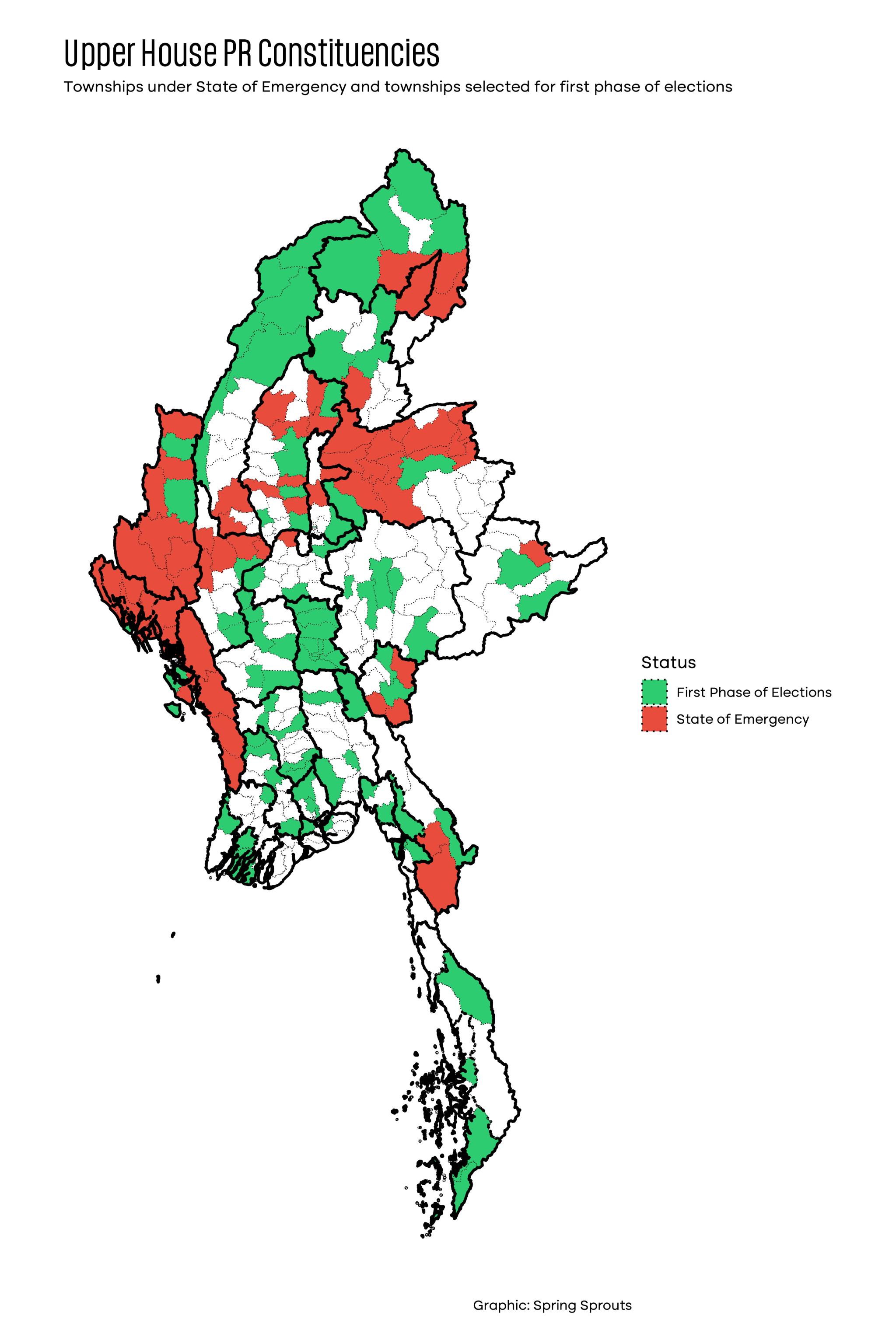
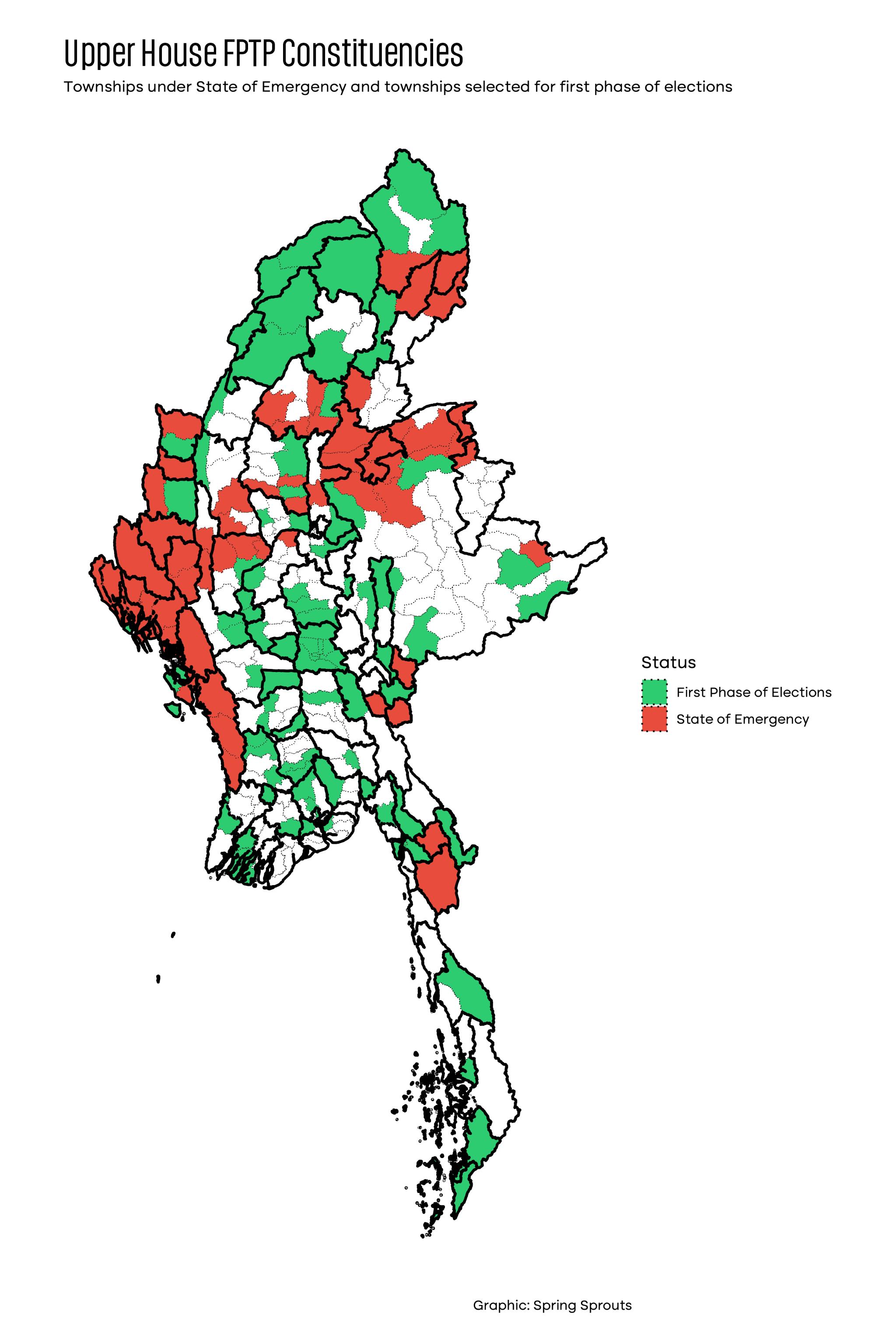
PR constituencies are usually drawn at the national level or by combining large regions (for example, two or three states), but the junta further divided each state into two or three PR constituencies. Such division raises the vote share needed to win a seat (the threshold) and will lead to domination by the strongest party.
A clear example is Rakhine State, where of the three townships in which the election can be held, one forms PR Constituency 1 and the other two form Constituency 2. In this way, by opening polling stations in just three townships, six seats can be filled for the whole of Rakhine State, plus two more under FPTP. In a state like Rakhine with 17 townships, filling 8 of its 12 Amyotha Hluttaw seats by holding a patchwork election in just three townships is a major example of disenfranchisement, with millions of eligible voters left out.
In addition, because the law requires each self-administered area to be designated as its own constituency when setting the six FPTP Amyotha Hluttaw seats per state, in Shan State, five self-administered areas covering 11 of its 51 townships each get a single-member constituency, while all the remaining 40 townships are combined into a single constituency, causing severe malapportionment between the number of voters and the number of representatives.
Rather than its stated aim of promoting broad participation, the junta's mixed electoral system is designed to guarantee a clear advantage for the dominant party (USDP) after holding a few patchwork elections in constituencies.
Holding the Election in Phases
The junta plans to hold the election in phases, and has announced that the first phase will take place in 102 townships on December 28. The townships in each phase are scattered across the country.
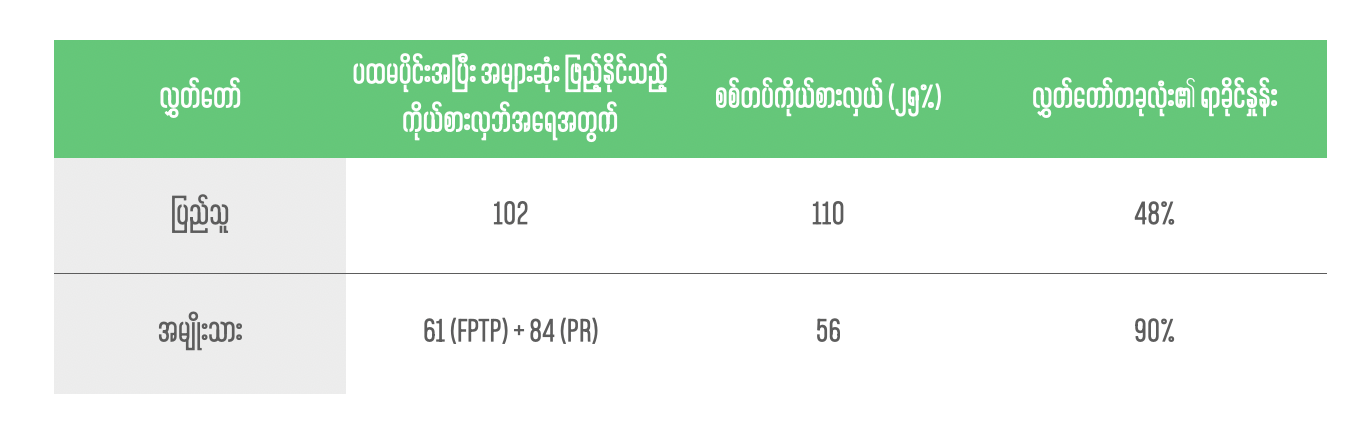
It is clear that, after drawing constituencies as it likes, the junta has prepared to fill most seats after just the first phase of the phased election. Even if the election cannot be held in some areas, it can proceed with the first-phase results alone. This is an attempt to keep control so that the seats it needs are not affected even if circumstances change.
Another possible reason for phased voting is to control outcomes for the junta-backed party as needed, depending on first-phase results. If the first phase goes badly, it may try to change the outcome before the second phase by all kinds of means, from vote-buying to violent intimidation.
Untrustworthy Electronic Voting and the UID System
The junta has been preparing to use electronic voting since 2020. There are clearly many worrying issues with its implementation. Whether voting is truly secret under a system directly controlled by the junta will be a threat to every voter. It is also unclear which company is involved in implementing the system and how people's personal data will be handled, which could have long-term data security consequences. Considering that personal data is already being used for widespread arrests at airports, the long-term impact on data security could be severe.
Moreover, linking the voter list to the UID (Unique Identification Number) system could become a way to pressure and intimidate people into voting. The amended laws also provide for "temporary absentees" to cast advance votes for their constituency. It is necessary to be aware that pressure, threats and repression may follow based on whether people vote or not.
Intimidation Through Repressive Laws
Just as it suspended key provisions of the Law Protecting the Personal Freedom and Personal Security of Citizens the day after announcing the election, the junta has also enacted and brought into force new repressive laws.
On July 30, it announced the entry into force of the Cyber Security Law, which further restricts freedom of expression online, criminalizes the use of VPNs to access internet services including Facebook, a social network used by most people, and serves as a weapon for internet shutdowns and the collection and retention of personal data.
In addition, on July 29 it enacted the "Law on Protection of Multi-Party Democratic General Elections from Obstruction, Disruption and Sabotage". In line with laws designed for repression, its broad prohibitions, starting from speaking or organizing to disrupt the election, carry severe penalties from three years' imprisonment up to the death penalty. It is a clear threat that no criticism or discussion of the election will be tolerated and will be severely repressed.
Conclusion
Although many have pointed out that the junta's election is not a genuine election, there is still little discussion of its potential long-term harms. The building of an abnormal political system and political machinery is designed solely to keep the junta in power, and it is plain to see that behind superficial promises lie only the short-term results and long-term interests of the junta and its backed political party. Legitimacy cannot be manufactured through an illegitimate process.
Sources1. https://www.moi.gov.mm//mal/sites/default/files/newspaper-pdf/2025-08/mal%201.8.25_0.pdf
2. https://acleddata.com/conflict-data
3. https://www.uec.gov.mm/pages.php?pagename=ဥပဒေ&menu=ဥပဒေ
4. https://news-eleven.com/article/304968
5. https://www.burmalibrary.org/sites/burmalibrary.org/files/obl/mal_2.1.25.pdf
6. https://www.moi.gov.mm//mal/sites/default/files/newspaper-pdf/2025-07/mal30-7-25.pdf
Related updates
Mandalay Region Interim Political Arrangement
The "Mandalay Region Interim Political Arrangement" (draft) has been written with 12 chapters and will soon be adopted. The draft has been officially released so that revolutionary political forces across the country, including Mandalay revolutionary forces and the public, can review it and send suggestions, and it is being further revised based on the suggestions received. Chapters 1 to 3 of the draft cover objectives, values and basic principles, and Chapter 4 covers fundamental rights, entitlements and duties. Chapters 5 to 10 cover the structure of the Mandalay region and its legislative, executive and judicial branches, Chapter 11 covers amendment of the arrangement, and Chapter 12 contains general provisions.
Introducing the Arrangement for Transitional Constitution (AFTA)
As the Spring Revolution has championed "ending military dictatorship and building a federal democratic union", discussions on the constitution have been taking place since February 2021. Revolutionary forces have rejected and opposed the 2008 Constitution, controversially adopted under military dictatorship, and revolutionary organizations have declared it void. During the revolution, Parts 1 and 2 of the Federal Democracy Charter have been issued and used as a constitutional framework. The roadmap set out in the charter also includes, as one of its stages, drafting a constitution for the post-revolutionary transition period during the revolution itself.
ASEAN, the UN and International Engagement on Myanmar in October
October was a period when Myanmar's affairs were once again discussed on the world political stage, with the ASEAN Summit and the UN General Assembly. Below is a summary report of international developments on Myanmar during October.
Mandalay Interim Arrangement Drafted Through Chapter 9
In Announcement No. 4/2025 issued on February 26, the Working Committee for Coordination and Drafting of the Interim Political Arrangement announced that the Mandalay Region Interim Arrangement is being drafted with public input and that nine chapters have been drafted so far.