
The background of the formation of the Chin State Council
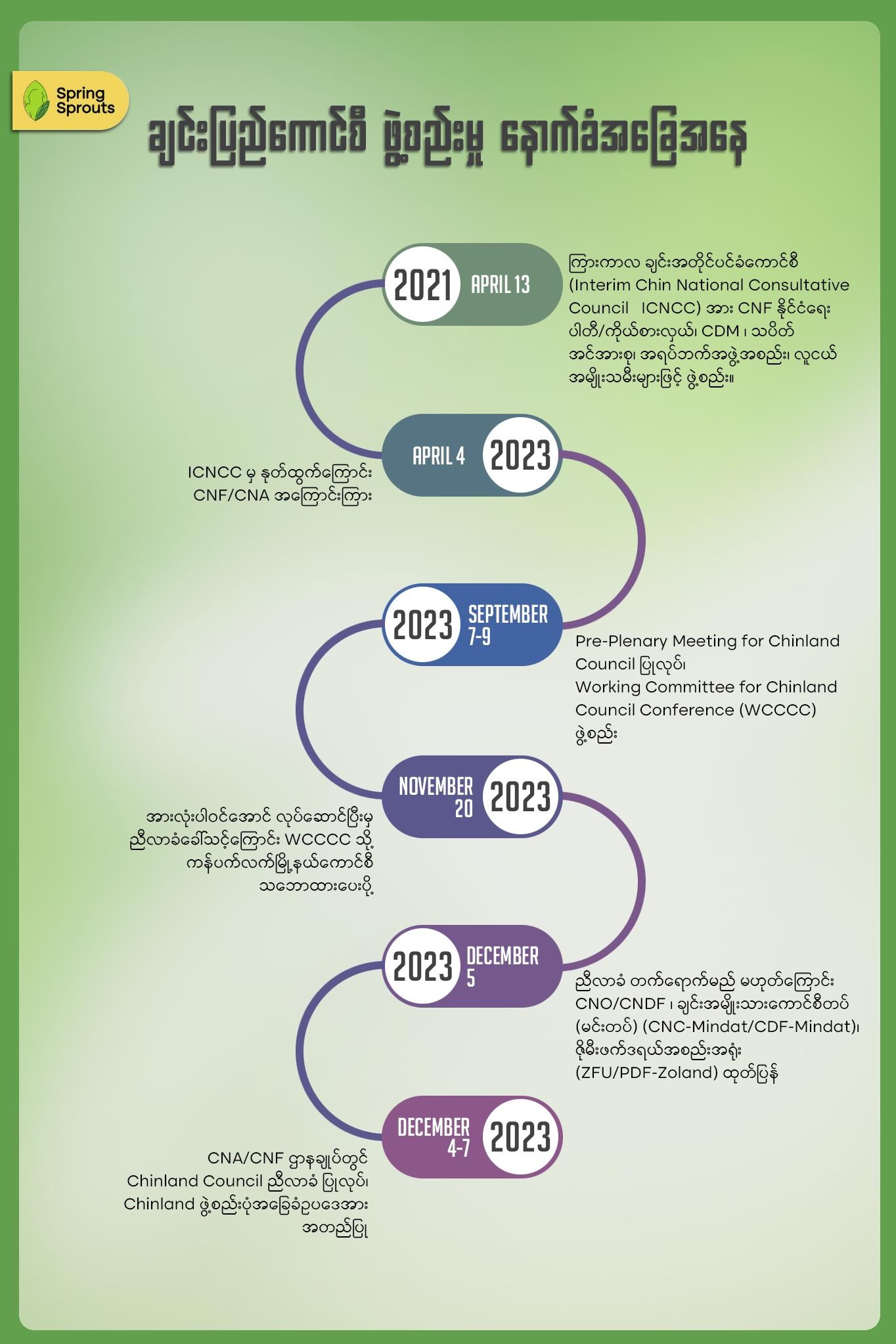
During the Spring Revolution, the Chin National Front (CNF), Political parties and parliamentarians who won the 2020 election and opposed the military group, CDM staff, strikes, civil society organizations, youth and women established the Interim Chin National Consultative Council (ICNCC) to manage political activities on behalf of the Chin country and the Chin people. It was formed on April 13, 2021 . ICNCC annoused that it will organize the Chin state government, and handle the legislative issues, administrative issues and judiciary issues. It is also a member organization of the National Unity Consultative Council (NUCC).
In May 2021, it was further annouced that it has formed a committee to draft the Chin charter to obtain the Chin charter for the formation of the government and it is trying to get the Single text drat and working to confirm the results obtained through extensive discussions with the Chin revolutionary forces.
On April 4, 2023, ICNCC was notified of the resignation of CNF from the Council in accordance with Resolution 2 (a) of the CNF Central Working Committee Coordination Meeting.
CNF organized 108 representatives fromChin Hluttaw representatives, township and regional organizations and held the Pre-Plenary Meeting for Chinland Council from September 7 to 9, 2023.
During this meeting, it was agreed tothe emergence of the Chinland Constitution during the revolutionary period, the formation of Chinland Council and the establishment of the three pillars of Chinland, and formed the Working Committee for Chinland Council Conference (WCCCC). The WCCCC carried out the drafting of the constitution.
On the 20th of November, the Kanpatlet Township Council sent an opinion to the Working Committee that it was concerned that the decision to proceed withouth the full participation of various communities in the state could lead to a path of unnecessary conflict and that a conference should be convened with the involvement of all stakeholders in the state.
The Chin National Council (Mindat) (CNC-Mindat/CDF-Mindat), the Chin National Organization (CNO/CNDF), the Zomi Federal Union (ZFU/PDF-Zoland) released a statement on December 5 and mentioned that it will not attend the conference as it does not meet the democratic standard and will not be able to represent the unity of the entire Chin nation.
Under the leadership of WCCCC, the Chinland Council Conference was held from December 4th to 7th at the CNF headquarters in Victoria Camp. The conference, which was attended by 235 domestic and international guests, including group representatives, and approved the Constitution of Chinland .
At the same time, the council issued a statement 1/2023 and annouced that the council was formed with 140 representatives and council steering group was formed with 23 people from these three groups, and the council was formed with the purpose of building the Chin land, which guaranteed the right of national self-determination, building a federal union and building a democratic system, and within 60 days after the formation of the council, the State Hluttaw, the state government and the state Supreme Court will be formed.
Provisions of the Constitution of Chinland
The approved Constitution of Chinland has 10 chapters. They are (1) Basic Principles (2) Chinland Structure (3) Chinland Council (4) Legislative (5) Executive (6) Judiciary (7) Defense and Security Council (8) Local Government (9) Election (10) ) general provisions.
The leading members of the council are limited that the are not allowed to serve in the National Unity Government (NUG) as well as the state government, parliament and the Supreme Court. Although the Prime Minister is designated as the head of government in the government structure, the chairman of the Chinland Council is also the head of state as well as the chairman of the Chinland Defense and Security Council according to the enacted law, .
The government is divided into two parts: the revolutionary period and the transitional period. After the revolutionary period ends, the Chinland revolutionary government must be transformed into a transitional government.
Related updates
A House Built on Sand – The Junta's Election Plan
Gerrymandering means grouping or spreading out areas of assured support so that the outcome a party needs can be shaped as desired. For the junta, it has already created conditions in which only its backed Union Solidarity and Development Party (USDP) and a few supporting parties can contest and win, having dissolved major parties such as the National League for Democracy (NLD) and the Shan Nationalities League for Democracy (SNLD) amid a broad political boycott. In that situation, it needs to create the appearance that the election can be held widely.
Mandalay Region Interim Political Arrangement
The "Mandalay Region Interim Political Arrangement" (draft) has been written with 12 chapters and will soon be adopted. The draft has been officially released so that revolutionary political forces across the country, including Mandalay revolutionary forces and the public, can review it and send suggestions, and it is being further revised based on the suggestions received. Chapters 1 to 3 of the draft cover objectives, values and basic principles, and Chapter 4 covers fundamental rights, entitlements and duties. Chapters 5 to 10 cover the structure of the Mandalay region and its legislative, executive and judicial branches, Chapter 11 covers amendment of the arrangement, and Chapter 12 contains general provisions.
Introducing the Arrangement for Transitional Constitution (AFTA)
As the Spring Revolution has championed "ending military dictatorship and building a federal democratic union", discussions on the constitution have been taking place since February 2021. Revolutionary forces have rejected and opposed the 2008 Constitution, controversially adopted under military dictatorship, and revolutionary organizations have declared it void. During the revolution, Parts 1 and 2 of the Federal Democracy Charter have been issued and used as a constitutional framework. The roadmap set out in the charter also includes, as one of its stages, drafting a constitution for the post-revolutionary transition period during the revolution itself.
NUG Deputy Minister of Human Rights Granted Leave from Duties
The NUG announced on March 7 that Khun Bedu Htan, one of the deputy ministers of the National Unity Government (NUG) Ministry of Human Rights, had been granted leave from his duties.